Here you being my view of worldwide warfare, with videos from YouTube and notebooks provientes from Wikipedia. I hope you like my blog, and they are always wanting to comment without taboos. Enjoying this world of strategy!
Descended from a long line of Celts, the warlike Arverni are one of the most powerful tribes of central Gaul. Far more than mere barbarian looters and raiders, they have a complex and sophisticated culture centred at Nemossos, their stronghold near the Gergovia plateau.
Ruled by kings and tribal chieftains, but deferent to their druids, there exists a rigid social order amongst the Arverni. Prestige and power come from a man's abilities as a warrior and a leader as much as his lineage. Heavily dependent on infantry, the Arverni make great use of javelins and the devastating impact of the charge, led by elite warriors such as Spear Nobles and Oathsworn. It is by fighting this way that leaders have earned their places: as champions, proving themselves in conflict.
While many matters ostensibly fall to the Arverni's kings and chieftains, in reality, much is governed by the will of the druids, including declarations of war or peace. Blending animism with a pantheon of greater, local and lesser household gods, the Celtic religion is one of the key factors uniting the disparate Gallic tribes.
Seemingly unstoppable en masse, Gallic tribes sacked Rome in 390BC and terrorised much of the Aegean as recently as 279BC, invading Thrace, Macedon and Illyria. Maybe their destiny lies across the sea to Britannia, with all the Celtic tribes united under a single king? Or to the south, to finally put paid to the growing threat from Rome?
Noted craftsmen, the Arverni enjoy improved income from their artisans, as well as profiting from the Gauls’ expertise with gold-working. In battle, their cavalry benefit from natural Gallic horsemanship, while the charisma and fighting prowess of their kings and chieftains make them formidable warriors, and earns them diplomatic respect amongst other barbarian tribes.
An Iron Age tribe of southern Britain, the Iceni are a proud and fierce people. They inhabit the flatlands, marshes and fens that border the North Sea, south of the Wash. They are practiced raiders, and frequently engage in battle with their tribal neighbours, the Coritani and Atrebates.
The Iceni principally make use of infantry when at war. Equipped with large oval or sub-rectangular shields and either a sword or spear, their main distinction from the Celtic tribes of the continent is the practice of painting or tattooing their skin, combined with a greater use of slings in battle. Although light cavalry are used, the Iceni and other British tribes are famed for their highly manoeuvrable war-chariots. After harrying the enemy with javelins, warriors dismount and engage in a fashion similar to the Homeric champions.
Far from simple barbarians, the Iceni have established a capital, known as Venta Icenorum, as well as large religious centres. Although based on agriculture, their economy is sophisticated – they even mint their own coins. Their culture, craft and wealth are illustrated in the form of fantastic gold torques and other jewellery worn by their nobles.
As a playable faction, The Iceni are brave and warlike; invoking the goddess Andraste as they charge into battle drives them to even greater feats of valour. Their expertise with iron makes the resource a particularly effective form of income for the tribe, as does their skill at raiding and looting. And as a warrior society, the happiness of the people increases with every fresh declaration of war.
The Iceni have the potential to dominate the Iron Age tribes of Britain. Beyond their shores lie Celtic Gaul and Iberia… can the Iceni unite them all under their banner?
“Glory, order, power.” Desperate to reclaim its past glory, Macedon finds itself locked into its pre-Alexandrian borders by the Illyrians, Thracians and Greek city states on all sides. Can the Macedonian Empire rise again under a new Alexander?
Macedon is an administration, with the king holding power and governing in the name of the people. This distinction extends to the treasury, fuelled by an economy of agriculture, forestry and the taxation of ports, the exception being the gold and silver mines granted to the king.
Macedon’s armies remain set on the pattern developed by Phillip II and Alexander, focusing primarily on infantry and cavalry, and led by heroic commanders. Little has changed in terms of tactics, technology or siegecraft since the glory days, with a continuation of Alexander’s hoplite reforms and reliance on the famed Companion and Thessalian cavalry. Never a strong naval power, Macedon has long relied upon its sea-faring Hellenistic subjects, such as Athens and Rhodes.
As a Successor State, Macedon gains advantages when fighting other Hellenic factions, and enjoys improved income and provincial growth from every client state owned. Experienced warriors, the armies of Macedon also have an advantage when fighting against barbarians.
Under the leadership of Antigonus Gonatus, they are gracious rulers and shrewd tradesmen, enjoying bonuses to income and population happiness. However, the other Hellenistic states find it hard to forgive Macedon’s hegemonic tendencies, and as such, the Macedonian player will have a harder time winning their trust and allegiance.
Faction two has just been announced: it's Carthage! Here's a brand new screenshot and a whole load of information on the second playable faction in Total War: Rome II! Carthage
“Democracy, commerce, faith" The beating heart of Carthage is the city itself, a major port and bustling trade hub nestling on the North African coast. Since gaining independence from its Phoenician forbears, it has quickly established a considerable military, naval and trade empire of its own. Holding the same polytheistic beliefs as their ancestors, the Carthaginians worship many gods, chief amongst them Ba’al Hammon, The Ruler Of The Multitudes, and Tanit, the patron goddess of Carthage itself. Many people believe that child sacrifice takes place at their temples. Carthage is an expansionist trading state with a small indigenous population. As such, the bulk of its armies consist of mercenary units. The core of its land forces, however, are elite Carthaginian citizens known as the Sacred Band and mighty war elephants from the forests of North Africa. Accomplished seamen, their ships are fast and manoeuvrable, with good ramming and missile capabilities. Since the 6th century BC, Carthage has enjoyed a commercial treaty with Rome. The nations even fought together during the Pyrrhic War, although this was a marriage of convenience to prevent Greek hegemony of Southern Italy and Sicily. The outcome of that war was perhaps better for Rome; Carthage gained a foothold in Sicily, but Rome achieved dominance over much of the Italian peninsula. Now, tensions run high between these mighty nations…. As a playable faction, Carthage benefits from its mastery of the waves and its heritage as a great trading nation. As a democracy, it also enjoys an improved level of population happiness. The player also has the choice to play as one of three major political powers, each of which confers further military, economic and cultural benefits.
"The Roman Republic is in a period of major growth. Pyrrhus and his
invading Greek warriors have been driven from the shores of Italy, and
the burgeoning Republic boasts the military muscle to match its
ambition. Rome is the dominant power on the Italian peninsula, and
stands at a turning point in history. But to expand, she must conquer.
To the North lies the Estruscan League, and beyond, the Barbarian lands.
To the east lie the Greeks, and to the south and west, the
Carthaginians…
Since throwing off the
rule of the Etruscan Kings in around 500BC, the Roman Republic has come
to represent a power like no other. Military service is mandatory for
citizens, and one of the most profound contributions a citizen can make.
This makes the Republic militaristic at its very heart.
As a playable faction,
Rome benefits economically from its excellence in metalwork, enjoys
enhanced military development, and can exploit the masses in order to
maintain public order. Furthermore, the player will choose to conduct
the affairs of Rome as the head of one of three great Roman houses: The
Julia, The Cornelia, and the Junia, each of which bring further
economic, military and cultural benefits.
Ranging
from the Spanish coast to the far-flung, exotic kingdoms of the east,
the campaign map for Total War: ROME II™ is breath-taking in scope, and a
study in detail and variety. This page is your source for background
information about each of the playable factions: their starting position
on the campaign map, their civic and military focus, and some of their
key battlefield units.
The
playable factions represent key powers within the Greco-Roman,
Barbarian, and Eastern cultures, and each offers a notably different and
deeper form of gameplay experience from those in previous Total War
games. Each brings unique commercial, military and political strengths,
its own agents and political system, and three tech trees representing
civic, military and engineering disciplines. Each will have its own
dilemmas to face and different styles of army to manage. Some factions
are split into a number of playable families, which bring further unique
benefits to their base faction traits.
Players
will need to work with – and in certain circumstances against – their
faction’s internal political system. You’ll direct the actions of famous
characters from history, and if they’re not out in the field commanding
your armies, they’ll be politicking in the senate house, or its
cultural equivalent. Players would be wise to keep an eye on such
individuals…
Some
factions rely more on mercenaries for their military might; some prefer
to train their own. Some rely on client-nations or vassals to boost
their economic growth, while others are more trade-focussed. Whichever
you choose, each faction brings a completely different gameplay
experience to Total War: ROME II™.
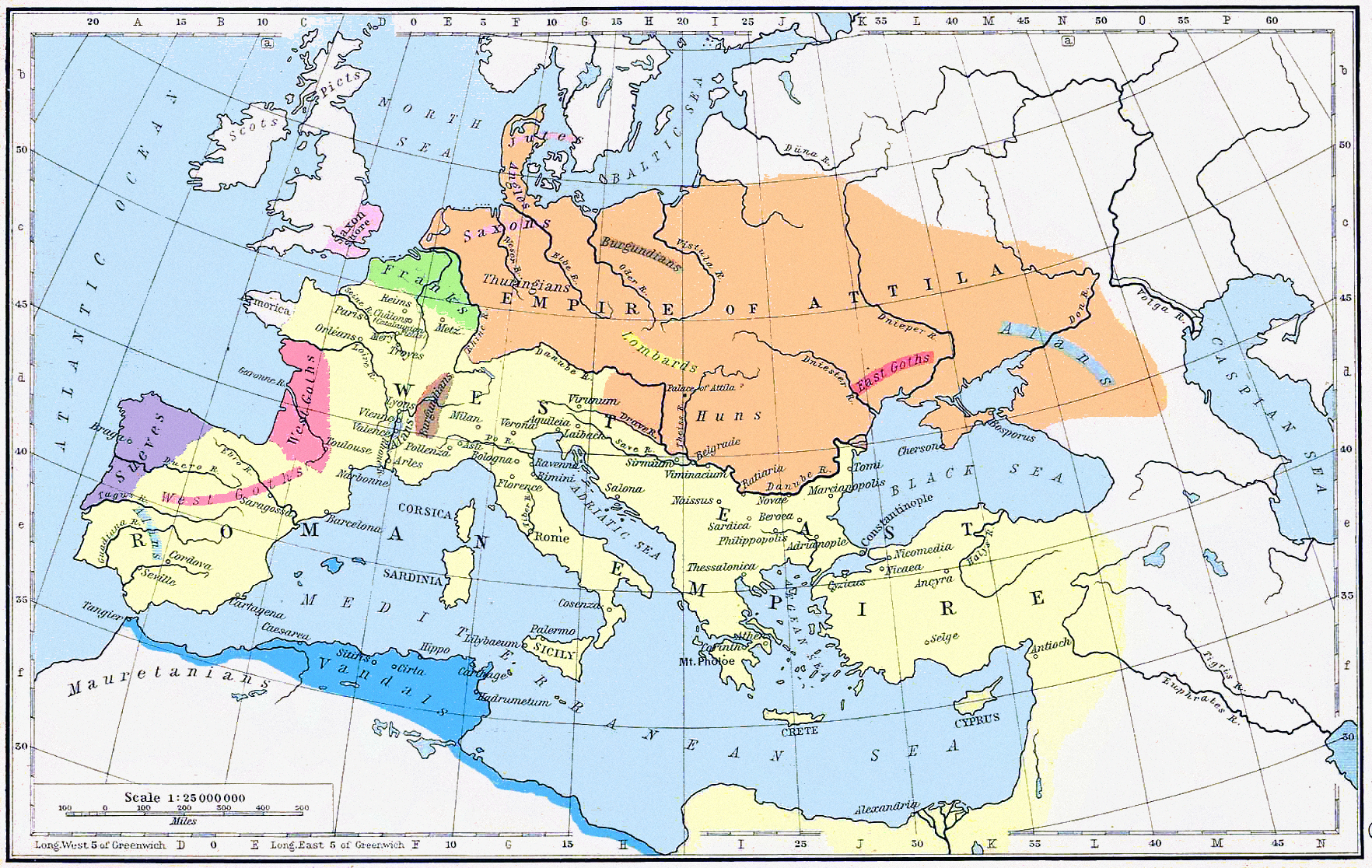
The Huns were a group of Eurasian nomads, appearing from east of the Volga, who migrated into Europe by the year 370 and built up an enormous empire there. Their main military techniques were mounted archery and javelin throwing. They were possibly the descendants of the Xiongnu who had been northern neighbours of China three hundred years before and may be the first expansion of Turkic people across Eurasia.
Flavius Aetius was born at Durostorum in Moesia Inferior (modern Silistra, Bulgaria), around 390. His father was Flavius Gaudentius, a known Roman soldier of Scythian extraction, and his mother, whose name is unknown, was a wealthy aristocratic woman of Italian ancestry. As a boy, Aëtius was at the service of the imperial court, enrolled in the military unit of the tribuni praetoriani partis militaris. Between 405 and 408 he was kept as hostage at the court of Alaric I, king of the Visigoths. In 408 Alaric asked to keep Aëtius as a hostage, but was refused, as Aëtius was sent to the court of Rugila, king of the Huns. Aëtius's upbringing amongst militaristic peoples gave him a martial vigour not common in Roman generals of the time. In 423 the Western Emperor Honorius died. The most influential man in the West, Castinus, chose as his successor Joannes, a high-ranking officer. Joannes was not part of the Theodosian dynasty and he did not receive the recognition of the eastern court. The Eastern Emperor Theodosius II organized a military expedition westward, led by Ardaburius and his son Aspar, to put his cousin, the young Valentinian III (who was a nephew of Honorius), on the western throne. Aëtius entered the service of the usurper as cura palatii and was sent by Joannes to ask the Huns for assistance. Joannes lacked a strong army and fortified himself in his capital, Ravenna, where he was killed in the summer of 425. Shortly afterwards, Aëtius returned to Italy with a large force of Huns to find that power in the west was now in the hands of Valentinian III and his mother Galla Placidia. After fighting against Aspar's army, Aëtius managed to compromise with Galla Placidia. He sent back his army of Huns and in return obtained the rank of comes et magister militum per Gallias, the commander in chief of the Roman army in Gaul. The death of Rugila (also known as Rua or Ruga) in 434 left the sons of his brother Mundzuk, Attila and Bleda (Buda), in control of the united Hun tribes. At the time of two brothers' accession, the Hun tribes were bargaining with Eastern Roman Emperor Theodosius II's envoys for the return of several renegades (possibly Hunnic nobles who disagreed with the brothers' assumption of leadership) who had taken refuge within the Eastern Roman Empire. The following year Attila and Bleda met with the imperial legation at Margus (present-day Požarevac, eastern Serbia) and, all seated on horseback in the Hunnic manner, negotiated a successful treaty. The Romans agreed to not only return the fugitives, but to also double their previous tribute of 350 Roman pounds (ca. 115 kg) of gold, to open their markets to Hunnish traders, and to pay a ransom of eight solidi for each Roman taken prisoner by the Huns. The Huns, satisfied with the treaty, decamped from the Roman Empire and returned to their home in the Hungarian Great Plain, perhaps to consolidate and strengthen their empire. Theodosius used this opportunity to strengthen the walls of Constantinople, building the city's first sea wall, and to build up his border defenses along the Danube. The Huns remained out of Roman sight for the next few years while they invaded the Sassanid Empire. When defeated in Armenia by the Sassanids, the Huns abandoned their invasion and turned their attentions back to Europe. In 440 they reappeared in force on the borders of the Roman Empire, attacking the merchants at the market on the north bank of the Danube that had been established by the treaty. Crossing the Danube, they laid waste to the cities of Illyricum and forts on the river, including Viminacium, a city of Moesia (south bank of the Danube River). Their advance began at Margus, where they demanded that the Romans turn over a bishop who had retained property that Attila regarded as his. While the Romans discussed turning the Bishop over, he slipped away secretly to the Huns and betrayed the city to them. While the Huns attacked city-states along the Danube, the Vandals led by Geiseric captured the Western Roman province of Africa and its capital of Carthage. Carthage was the richest province of the Western Empire and a main source of food for Rome. The Sassanid Shah Yazdegerd II invaded Armenia in 441. The Romans stripped the Balkan area of forces needed to defeat the Vandals in Africa which left Attila and Bleda a clear path through Illyricum into the Balkans, which they invaded in 441. The Hunnish army sacked Margus and Viminacium, and then took Singidunum (modern Belgrade, capital of Serbia) and Sirmium (Pannonia, in northwest of Serbia). During 442, Theodosius recalled his troops from Sicily and ordered a large issue of new coins to finance operations against the Huns. Believing he could defeat the Huns, he refused the Hunnish kings' demands. Attila responded with a campaign in 443. Striking along the Danube, the Huns, equipped with new military weapons like the battering rams and rolling siege towers, overran the military centres of Ratiara and successfully besieged Naissus (modern Niš, southern Serbia). Advancing along the Nisava River, the Huns next took Serdica, Philippopolis, and Arcadiopolis. They encountered and destroyed a Roman army outside Constantinople but were stopped by the double walls of the Eastern capital. They defeated a second army near Callipolis (modern Gallipoli, a Hellespont-port). Theodosius, stripped of his armed forces, admitted defeat, sending the Magister militum per Orientem Anatolius to negotiate peace terms. The terms were harsher than the previous treaty: the Emperor agreed to hand over 6,000 Roman pounds (ca. 2000 kg) of gold as punishment for having disobeyed the terms of the treaty during the invasion; the yearly tribute was tripled, rising to 2,100 Roman pounds (ca. 700 kg) in gold; and the ransom for each Roman prisoner rose to 12 solidi. Their demands were met for a time, the Hun kings withdrew into the interior of their empire. Following the Huns' withdrawal from Byzantium (probably around 445), Bleda died. Attila then took the throne for himself, becoming the sole ruler of the Huns.
From 433 to 450, Aetius was the dominant personality in the Western Empire, obtaining the patrician rank (5 September 435) and playing the role of "protector" of Galla Placidia and Valentinian III while the Emperor was still young. At the same time he continued to devote attention to Gaul. In 436, the Burgundians of King Gunther were defeated and obliged to accept peace by Aetius, who, however, the following year sent the Huns to destroy them; 20,000 Burgundians were killed in a slaughter which probably became the basis of the Nibelungenlied, a German epic. That same 436 Aetius was probably in Armorica with Litorius to suppress a rebellion of the Bacaudae. Year 437 saw his second consulship and the wedding of Valentinian and Licinia Eudoxia in Constantinople; it is probable that Aetius attended at the ceremony that marked the beginning of the direct rule of the Emperor. The following two years were occupied by a campaign against the Suebi and by the war against the Visigoths; in 438 Aetius won a major battle (probably the battle of Mons Colubrarius), but in 439 the Visigoths defeated and killed his general Litorius and obtained a peace treaty. On his return to Italy, he was honoured by a statue erected by the Senate and the People of Rome by order of the Emperor; this was probably the occasion for the panegyric written by Merobaudes. In 443, Aëtius settled the remaining Burgundians in Savoy, south of Lake Geneva. His most pressing concern in the 440s was with problems in Gaul and Iberia, mainly with the Bagaudae. He settled Alans around Valence and Orléans to contain unrest around present-day Brittany (Peninsula on the north-west of France). The Alans settled in Armorica caused problems in 447 or 448. It was probably in that period that he fought a battle near Tours, followed by a Frankish attack under Clodio to the region near Arras, in Belgica Secunda; the invaders were stopped by a battle around a river-crossing near Vicus Helena, where Aëtius directed the operations while his commander Majorian (later Emperor) fought with the cavalry. However, in 450 Aëtius had already returned in good terms with the Franks. In that year, in fact, the king of the Franks died, and the patricius supported his younger son's claim to the throne, adopting him as his own son and sending him from Rome, where he had been sent as ambassador, to the Frankish court with many presents.
In 447 Attila again rode south into the Eastern Roman Empire through Moesia. The Roman army under the Gothic magister militum Arnegisclus met him in the Battle of the Utus (on Vit river in Bulgaria) and was defeated, though not without inflicting heavy losses. The Huns were left unopposed and rampaged through the Balkans as far as Thermopylae. Constantinople itself was saved by the Isaurian troops of the magister militum per Orientem Zeno and protected by the intervention of the prefect Constantinus, who organized the reconstruction of the walls that had been previously damaged by earthquakes, and, in some places, to construct a new line of fortification in front of the old. An account of this invasion survives: -The barbarian nation of the Huns, which was in Thrace, became so great that more than a hundred cities were captured and Constantinople almost came into danger and most men fled from it. And there were so many murders and blood-lettings that the dead could not be numbered. Ay, for they took captive the churches and monasteries and slew the monks and maidens in great numbers. (Callinicus, in his Life of Saint Hypatius)
In 450, Attila proclaimed his intent to attack the Visigoth kingdom of Toulouse by making an alliance with Emperor Valentinian III. He had previously been on good terms with the Western Roman Empire and its influential general Flavius Aetius. The troops Attila provided against the Goths and Bagaudae had helped earn him the largely honorary title of magister militum in the west. The gifts and diplomatic efforts of Geiseric, who opposed and feared the Visigoths, may also have influenced Attila's plans. However, Valentinian's sister was Honoria, who, in order to escape her forced betrothal to a Roman senator, had sent the Hunnish king a plea for help – and her engagement ring – in the spring of 450. Though Honoria may not have intended a proposal of marriage, Attila chose to interpret her message as such. He accepted, asking for half of the western Empire as dowry.
Attila crossed the Rhine early in 451 with his followers and a large number of allies, sacking Divodurum (Metz, northeast of France ) on April 7. Other cities attacked can be determined by the hagiographic vitae written to commemorate their bishops: Nicasius was slaughtered before the altar of his church in Rheims; Servatus is alleged to have saved Tongeren with his prayers, as Genevieve is to have saved Paris. Lupus, bishop of Troyes, is also credited with saving his city by meeting Attila in person.
Attila's army had reached Aurelianum by June. This fortified city guarded an important crossing over the Loire. According to Jordanes, the Alan king Sangiban, whose foederati realm included Aurelianum, had promised to open the city gates; this siege is confirmed by the account of the Vita S. Anianus and in the later account of Gregory of Tours, although Sangiban's name does not appear in their accounts. However, the inhabitants of Aurelianum shut their gates against the advancing invaders. Attila began to besiege the city, while he waited for Sangiban to deliver on his promise.
Now you are about to see the view that the generals wish to have, and see the Roman legions with barbarian soldiers of the roman foederatiled by "the last of the true romans" against the strong and flexible hun cavalry and their supports led by the "Alexandre of Barbarians", the fight will decide the future of the romans empires and the peoplesbeyondthe Roman-European borders, and the world will not to be the same before!