sábado, 17 de novembro de 2012

History Channel Decisive Battles E12 The fall of the roman warfare, Edirne, European border of Turkey to Northeast Greece (9 August 378)

Valens and his brother Valentinian were both born in Cibalae (in present-day Croatia) into an Illyrian family in 328 and 321 respectively. They had grown up on estates purchased by their father Gratian the Elder in Africa and Britain. While Valentinian had enjoyed a successful military career prior to his appointment as emperor, Valens apparently had not. He had spent much of his youth on the family's estate and only joined the army in the 360s, participating with his brother in the Persian campaign of Emperor Julian.

In February 364, reigning Emperor Jovian, while hastening to Constantinople to secure his claim to the throne, was asphyxiated during a stop at Dadastana, 100 miles east of Ankara. Among Jovian's lieutenants was Valentinian, a tribunus scutariorum. He was proclaimed Augustus on 26 February, 364. Valentinian felt that he needed help to govern the large and troublesome empire, and, on 28 March of the same year, appointed his brother Valens as co-emperor in the palace of Hebdomon. The two Augusti travelled together through Adrianople and Naissus to Sirmium, where they divided their personnel, and Valentinian went on to the West.
Valens obtained the eastern half of the Empire Greece, Egypt, Syria and Anatolia as far east as Persia. Valens was back in his capital of Constantinople by December 364.
The election of Valens was soon disputed. Procopius, a Cilician maternal cousin of Julian, had been considered a likely heir to his cousin but was never designated as such. He had been in hiding since the election of Jovian. In 365, while Valentinian was at Paris and then at Rheims to direct the operations of his generals against the Alamanni, Procopius managed to bribe two legions assigned to Constantinople and take control of the Eastern Roman capital. He was proclaimed Augustus on September 28 and soon extended his control to both Thrace and Bithynia. War between the two rival Eastern Roman Emperors continued until Procopius was defeated. Valens had him executed on May 27, 366.
File:Theodosius I's empire.png
On August 4, 367, the eight-year-old Gratian was proclaimed as a third Augustus by his father Valentinian and uncle Valens, a nominal co-ruler and means to secure succession.

A re-enactor of a Roman soldier of the 3rd century A.D. Soldiers similar to this would have been used by the Romans.

Battle of Adrianople 1.png
This Gothic society faced internal strife and Hunnish attacks in the late 4th Century. As a result several groups sought refuge in the Roman Empire; two of the more successful groups, the Visigoths and Ostrogoths, absorbed smaller groups and gained independence within the Roman Empire. Another group, the Crimean Goths survived on the Black Sea. The Vandals and Burgundians shared similar histories.

In the summer and fall of 376, tens of thousands of displaced Goths and other tribes arrived on the Danube River, on the border of the Roman Empire, requesting asylum from the Huns.
The Goths, led by Alavivus and Fritigern, asked to be allowed to settle in the Roman Empire. Hoping that they would become farmers and soldiers, the emperor Valens allowed them to establish themselves in the Empire as allies (foederati).
Fritigern, a leader of the Thervingi, appealed to the Roman emperor Valens to be allowed to settle with his people on the south bank of the Danube, where they hoped to find refuge from the Huns, who lacked the ability to cross the wide river in force. Valens permitted this, and even helped the Goths cross the river, probably at the fortress of Durostorum (modern Silistra), Bulgaria.

Valens promised the Goths farming land, grain rations, and protection under the Roman armies as foederati. His major reasons for quickly accepting the Goths into Roman territory were to increase the size of his army, and to gain a new tax base to increase his treasury. The selection of Goths that were allowed to cross the Danube was unforgiving: the weak, old, and sickly were left on the far bank to fend for themselves against the Huns. The ones that crossed were supposed to have their weapons confiscated; however, the Romans in charge accepted bribes to allow the Goths to retain their weapons.

With so many people in such a small area, famine struck the Goths, and Rome was unable to supply them with either the food they were promised or the land; they herded the Goths into a temporary holding area surrounded by an armed Roman garrison. There was only enough grain left for the Roman garrison, and so they simply let the Goths starve. The Romans provided a grim alternative: the trade of slaves (often children and young women) for dog meat. When Fritigern appealed to Valens for help, he was told that his people would find food and trade in the markets of the distant city of Marcianople. Having no alternative, some of the Goths trekked south in a death march, losing the sickly and old along the path.
When they finally reached Marcianople's gates, they were barred by the city's military garrison and denied entry; to add insult to injury, the Romans unsuccessfully tried to assassinate the Goth leaders during a banquet. Open revolt began. The main body of Goths spent the rest of 376 and early 377 near the Danube plundering food from the immediate region. Roman garrisons were able to defend isolated forts but most of the country was vulnerable to Gothic plunder.
Valens then asked Gratian, the western roman emperor, for reinforcements to fight the Goths. Gratian sent the general Frigeridus with reinforcements, as well as the leader of his guards, Richomeres. For the next two years preceding the battle of Adrianople there were a series of running battles with no clear victories for either side.

In late winter 377 war began in earnest. The remaining Goths moved south from the Danube to Marcianople, and next appeared near Adrianople.
In 378, Valens decided to take control himself. Valens would bring more troops from Syria and Gratian would bring more troops from Gaul. The Roman response was to send a force under Valens to meet and defeat the Goths.
Valens left Antioch for Constantinople, and arrived on the 30th of May. He appointed Sebastianus, newly arrived from Italy, to reorganize the Roman armies already in Thrace. Sebastianus picked 2,000 of his legionaries and marched towards Adrianople. They ambushed some small Gothic detachments. Fritigern assembled the Gothic forces at Nicopolis and Beroe to deal with this Roman threat.

Gratian had sent much of his army to Pannonia when the Lentienses (part of the Alamanni) attacked across the Rhine. Gratian recalled his army and defeated the Lentienses near Argentaria (near Colmar, France.) After this campaign, Gratian, with part of his field army, went east by boat; the rest of his field army went east overland. The former group arrived at Sirmium in Pannonia and at the Camp of Mars (a fort near the Iron Gates), 400 kilometers from Adrianople, where some Alans attacked them. Gratian's group withdrew to Pannonia shortly thereafter.
Belligerents
Eastern Roman EmpireGoths
Commanders and leaders
† Emperor ValensFritigern
Alatheus
Saphrax
Strength
15-20,000 or25-30,00012-15,000 or20-25,000
Casualties and losses
10-15,000 or20,000 (roughly two-thirds of the Roman force)Unknown
After learning of Sebastian's success against the Goths, and of Gratian's victory over the Alamanni, Valens was more than ready for a victory of his own. He brought his army from Melanthias to Adrianople, where he met with Sebastian's force. On 6 August, reconnaissance informed Valens that about 10,000 Goths were marching towards Adrianople from the north, about 25 kilometers away. Despite the difficult ground, Valens reached Adrianople where the Roman army fortified its camp with ditch and rampart. Richomeres, sent by Gratian, carried a letter asking Valens to wait for the arrival of reinforcements from Gratian before engaging in battle. Valens' officers also recommended that he wait for Gratian, but Valens decided to fight without waiting, ready to claim the ultimate prize of victory.
Now you are about to see the view that the generals wish to have, and see the strong and new armed Roman legions led by a 70-old roman emperor against the strong robust goth infantry and cavalry, the fight will decide the future of the romans empires and the peoples beyond the Roman-European borders, and the world will not to be the same before!

sábado, 10 de novembro de 2012

History Channel Decisive Battles E11 The Vengeance of a Warrior queen, Battle of Watling Street, East of Wales-England border (AD 61)

In AD 43, Rome invaded south-eastern Britain. The conquest was gradual. While some kingdoms were defeated militarily and occupied, others remained nominally independent as allies of the Roman empire.
The Iceni allied with their neighbours the Trinovantes, whose former capital, Camulodunum (Colchester), was now a colony for Roman veterans.
One such people was the Iceni in what is now Norfolk. Their king, Prasutagus, secured his independence by leaving his lands jointly to his daughters and to the Roman emperor, Nero, in his will.
Tacitus and Dio agree that Boudica was of royal descent. Dio says that she was "possessed of greater intelligence than often belongs to women", that she was tall, had hair described as reddish-brown or tawny hanging below her waist, a harsh voice and a piercing glare, and habitually wore a large golden necklace, a many-coloured tunic, and a thick cloak fastened by a brooch.
Location of Iceni territory within England, Wales and Mann; modern county borders for England and Wales are shown for context.
Her husband, Prasutagus, was the king of Iceni, people who inhabited roughly what is now Norfolk. They initially were not part of the territory under direct Roman control, having voluntarily allied themselves to Rome following Claudius' conquest of AD 43. They were proud of their independence and had revolted in AD 47 when the then-governor Publius Ostorius Scapula threatened to disarm them. Prasutagus had lived a long life of conspicuous wealth and, hoping to preserve his line, made the Roman emperor co-heir to his kingdom, along with his wife and two daughters. It was normal Roman practice to allow allied kingdoms their independence only for the lifetime of their client king, who would agree to leave his kingdom to Rome in his will. Roman law also allowed inheritance only through the male line, so when Prasutagus died his attempts to preserve his line were ignored and his kingdom was annexed as if it had been conquered; lands and property were confiscated and nobles treated like slaves. According to Tacitus, Boudica was flogged and her daughters were raped. Cassius Dio says that Roman financiers, including Seneca the Younger, chose this time to call in their loans. Tacitus does not mention this, but does single out the procurator, Catus Decianus, for criticism for his "avarice". Prasutagus, it seems, had lived well on borrowed Roman money, and on his death his subjects had become liable for the debt.
But when he died, in 61 or shortly before, his will was ignored. The Romans seized his lands and violently humiliated his family: his wife, Boudica, was flogged and their daughters raped. Roman financiers called in their loans, which must have placed an increased burden of taxation on the Iceni.
File:British.coinage.Roman.invasion.jpg
In AD 60 or 61, while the current Roman Governor of Britain, Gaius Suetonius Paulinus, was leading a campaign against the island of Mona (modern Anglesey, north Wales) in the north of Wales, which was a refuge for British rebels and a stronghold of the druids, the Iceni conspired with their neighbours the Trinovantes, amongst others, to revolt. Boudica was chosen as their leader. According to Tacitus, they drew inspiration from the example of Arminius, the prince of the Cherusci who had driven the Romans out of Germany in AD 9, and their own ancestors who had driven Julius Caesar from Britain. Dio says that at the outset Boudica employed a form of divination, releasing a hare from the folds of her dress and interpreting the direction in which it ran, and invoked Andraste, a British goddess of victory.
The rebels' first target was Camulodunum (Colchester), the former Trinovantian capital and, at that time, a Roman colonia. The Roman veterans who had been settled there mistreated the locals and a temple to the former emperor Claudius had been erected there at local expense, making the city a focus for resentment. The Roman inhabitants sought reinforcements from the procurator, Catus Decianus, but he sent only two hundred auxiliary troops. Boudica's army fell on the poorly defended city and destroyed it, besieging the last defenders in the temple for two days before it fell. The future governor Quintus Petillius Cerialis, then commanding the Legio IX Hispana, attempted to relieve the city, but suffered an overwhelming defeat. His infantry was wiped out — only the commander and some of his cavalry escaped. The location of this famous battle is now claimed by some to be the village of Great Wratting, in Suffolk, which lies in the Stour Valley on the Icknield Way West of Colchester, and by a village in Essex. After this defeat, Catus Decianus fled to Gaul.
When news of the rebellion reached him, Suetonius hurried along Watling Street through hostile territory to Londinium. Londinium was a relatively new settlement, founded after the conquest of 43 AD, but it had grown to be a thriving commercial centre with a population of travellers, traders, and, probably, Roman officials. Suetonius considered giving battle there, but considering his lack of numbers and chastened by Petillius's defeat, decided to sacrifice the city to save the province.
Londinium was abandoned to the rebels who burnt it down, slaughtering anyone who had not evacuated with Suetonius. Archaeology shows a thick red layer of burnt debris covering coins and pottery dating before 60 AD within the bounds of Roman Londinium. Verulamium (St Albans) was next to be destroyed.
In the three settlements destroyed, between seventy and eighty thousand people are said to have been killed. Tacitus says that the Britons had no interest in taking or selling prisoners, only in slaughter by gibbet, fire, or cross. Dio's account gives more detail; that the noblest women were impaled on spikes and had their breasts cut off and sewn to their mouths, "to the accompaniment of sacrifices, banquets, and wanton behaviour" in sacred places, particularly the groves of Andraste.
Belligerents
Roman EmpireIceni, Trinovantes, and other British peoples
Commanders and leaders
Gaius Suetonius PaulinusBoudica †
Strength
10,000Tacitus claims 100,000;Dio claims 230,000;
While Boudica's army continued their assault in Verulamium (St. Albans), Suetonius regrouped his forces. According to Tacitus, he amassed a force including his own Legio XIV Gemina, some vexillationes (detachments) of the XX Valeria Victrix, and any available auxiliaries. The prefect of Legio II Augusta, Poenius Postumus, stationed near Exeter, ignored the call, and a fourth legion, IX Hispana, had been routed trying to relieve Camulodunum, but nonetheless the governor was able to call on almost ten thousand men.
Suetonius took a stand at an unidentified location, probably in the West Midlands somewhere along the Roman road now known as Watling Street, in a defile with a wood behind him — but his men were heavily outnumbered. Dio says that, even if they were lined up one deep, they would not have extended the length of Boudica's line. By now the rebel forces were said to have numbered 230,000, however, this number should be treated with scepticism — Dio's account is known only from a late epitome, and ancient sources commonly exaggerate enemy numbers.
Boudica exhorted her troops from her chariot, her daughters beside her. Tacitus gives her a short speech in which she presents herself not as an aristocrat avenging her lost wealth, but as an ordinary person, avenging her lost freedom, her battered body, and the abused chastity of her daughters. She said their cause was just, and the deities were on their side; the one legion that had dared to face them had been destroyed. She, a woman, was resolved to win or die; if the men wanted to live in slavery, that was their choice.
However, the lack of manoeuvrability of the British forces, combined with lack of open-field tactics to command these numbers, put them at a disadvantage to the Romans, who were skilled at open combat due to their superior equipment and discipline. Also, the narrowness of the field meant that Boudica could put forth only as many troops as the Romans could at a given time.
Now you are about to see the view that the generals wish to have, and see the the proud and upgraded Roman legions of the Emperor Nero against the rebellion of the British tribes led by the widow of a tribal chief, the fight will decide the future of Britain and the property of the Roman Empire, and the world will not be the same before!

History Channel Decisive Battles E10 The falling of eagle and the start of a new power, Battle of the Teutoburg Forest, Lower Saxony, northeast Germany (September​, 9 AD)

Recent archaeological finds place the battle at Kalkriese Hill in Osnabrück County, Lower Saxony. On the basis of Roman accounts, the Romans must at this time have been marching northwestward from the area that is now the city of Detmold, passing east of Osnabrück; they must then have camped in this area prior to being attacked.
The Roman force was led by Publius Quinctilius Varus, a noble from a patrician family related to the Imperial family and an experienced administrative official, who was assigned to consolidate the new province of Germania in the autumn of 6 AD. In early 6 AD, before Varus was commander on the Rhine, it was Legatus Gaius Sentius Saturninus and Consul Legatus Marcus Aemilius Lepidus under Tiberius who led an army of 65,000 heavy infantry legionaries, 10,000–20,000 cavalrymen, archers, 10,000–20,000 civilians (13 legions & entourage, probably about 100,000+ men) and was planning a major attack on Maroboduus, the king of the Marcomanni, a tribe of the Suebi who had fled the attacks of Drusus I in 9 BC into the territory of the Boii, where they formed a powerful tribal alliance with the Hermunduri, Quadi, Semnones, Lugians, Zumi, Butones, Mugilones, Sibini and Langobards.
Belligerents
Germanic tribes
(Cherusci, Marsi, Chatti,Bructeri, Chauci and Sicambri)
Roman Empire
Commanders and leaders
Arminius the GermanPublius Quinctilius Varus †
Strength
Unknown, but estimates range from 12,000–32,000.20,000–max.36,000:
3 Roman legions (XVII,XVIII/XIIX, and XIX/XVIIII);
3 alae (purely cavalry unit of the non-citizen auxilia corps);
6 auxiliary cohorts.

In 4 AD Tiberius entered Germania and subjugated the Cananefates in Germania Inferior, the Chatti near the upper Weser River, and the Bructeri south of the Teutoburg Forest and led his army across the Weser. But in 6 AD, a major rebellion broke out in the province of Illyricum. Led by Bato the Daesitiate, Bato the Breucian, Pinnes of Pannonia, and elements of the Marcomanni and known as the Bellum Batonianum, it lasted nearly 4 years. Tiberius was forced to stop his campaign against Maroboduus and recognise him as king and to send his eight legions to crush the rebellion in the Balkans.
Nearly half of all Roman legions had to be pulled together to end the revolt, which was triggered by neglect, endemic food shortages (since 22 BC, following a political crisis in 23 BC and riots in 22, 21 and 19 BC, ended after 8 AD), high taxes and harsh behavior of the tax collectors. This campaign, led by Tiberius and Quaestor Legatus Germanicus under Emperor Augustus, was one of the hardest and most critical for the Roman Empire. During the start of the rebellion in the southern part of Illyricum, Publius Quinctilius Varus, a noble from a patrician family related to the Imperial family, was named Legatus Augusti pro praetore and had only three legions available.
File:Der gescheiterte Varus Haltern.jpg
Varus' name and deeds were well known beyond the borders of the empire because of his ruthlessness and crucifixion of insurgents.[citation needed] While feared by the people, he was highly respected by the Roman senate. On the Rhine, he was in command of the legions XVII, XVIII (also XIIX) and XIX (also XVIIII), previously led by General Gaius Sentius Saturninus, who was sent back to Rome and had been given an ornamenta triumphalia. The other 2 legions in the winter-quarters of the army at castrum Moguntiacum (I Germanica, V Larks ) were led by Varus' nephew Second consul Lucius Nonius Asprenas and perhaps Second consul Lucius Arruntius.
Varus' opponent, Arminius, was handed over to the Romans along with his brother Flavus, as tribute by his father and chieftain of the noblest house in the tribe of the Cherusci, Segimerus the Conqueror, as result of the attacks of Drusus in 11 to 9 BC. Arminius had lived in Rome as a hostage in his youth, where he had received a military education, and even been given the rank of Equestrian.
During his absence Segimerus was declared a coward by other Germanic chieftains because he had bowed down to Roman rule – a crime punishable by death under Germanic law. Between 11 BC and 4 AD the hostility and suspicion between the Germanic tribes deepened. Trade and politics between the Germanic warlords deteriorated.
After his return from Rome, Arminius became a trusted advisor to Varus. But in secret he forged an alliance of Germanic tribes that had traditionally been enemies (the Cherusci, Marsi, Chatti, Bructeri, Chauci, Sicambri, and remaining elements of the Suebi), but whom he was able to unite due to outrage over Varus' tyrannous insolence and wanton cruelty to the conquered and who had hitherto submitted in sullen hatred to the Roman dominion.
Varus decided to quell this uprising immediately and take a detour through territory unfamiliar to the Romans. Arminius, who accompanied Varus, probably directed him along a route that would facilitate an ambush. Another Cheruscan nobleman, Segestes, brother of Segimerus, father of Arminius' wife, and opposed to the marriage, warned Varus the night before the departure of the Roman forces, allegedly even suggesting that Varus apprehend Arminius along with several other Germanic leaders whom he identified as covert participants in the planned uprising. But his warning was dismissed as the result of a personal feud. Arminius then left under the pretext of drumming up Germanic forces to support the Roman campaign, but instead led his troops, who must have been waiting in the vicinity, in attacks on surrounding Roman garrisons.
Varus' forces included three legions (Legio XVII, Legio XVIII, and Legio XIX), six cohorts of auxiliary troops (non-citizens or allied troops) and three squadrons of cavalry (alae), most of which lacked combat experience with Germanic fighters under local conditions. The Roman forces were not marching in combat formation, and were interspersed with large numbers of camp-followers. As they entered the forest (probably just northeast of Osnabrück), they found the track narrow and muddy; according to Dio Cassius a violent storm had also arisen.
Now you are about to see the view that the generals wish to have, and see the the proud and upgraded Roman legions of the Emperor Augustus against the union of the Germanic tribes led by a auxiliary commander of Roman army, the fight will decide the future of Germania and borders of the Roman Empire, and the world will not be the same before!
 

terça-feira, 6 de novembro de 2012

History Channel Decisive Battles E09 The ascension of a King of Rome, Battle of Pharsalus, central Greece (9 August 48 BC)

File:Cesare prima Gallia 58 a.C. jpg.jpg
Rimini083.jpgThe First Triumvirate (so denominated by Cicero), comprising Julius Caesar, Crassus, and Pompey, ascended to power with Caesar's election as consul, in 59 BC. The First Triumvirate was unofficial, a political alliance the substance of which was Pompey's military might, Caesar's political influence, and Crassus' money. The alliance was further consolidated by Pompey's marriage to Julia, daughter of Caesar, in 59 BC. At the conclusion of Caesar's first consulship, the Senate (rather than granting him a provincial governorship) tasked him with watching over the Roman forests. This job, specially-created by his Senate enemies, was meant to occupy him without giving him command of armies, or garnering him wealth and fame.
Caesar, with the help of Pompey and Crassus, evaded the Senate's decrees by legislation passed through the popular assemblies. By these acts, Caesar was promoted to Roman Governor ofIllyricum and Cisalpine Gaul. Transalpine Gaul (southern France) was added later. The various governorships gave Caesar command of an army of (initially) four legions. The term of his proconsulship, and thus his immunity from prosecution, was set at five years, rather than the customary one year. His term was later extended by another five years. During this ten-year period, Caesar used his military forces to conquer Gaul and invade Britain, without explicit authorisation by the Senate.
In 52 BC, at the First Triumvirate's end, the Roman Senate supported Pompey as sole consul; meanwhile, Caesar had become a military hero and champion of the people. Knowing he hoped to become consul when his governorship expired, the Senate, politically fearful of him, ordered he resign command of his army. In December of 50 BC, Caesar wrote to the Senate agreeing to resign his military command if Pompey followed suit. Offended, the Senate demanded he immediately disband his army, or be declared an enemy of the people: an illegal political bill, for he was entitled to keep his army until his term expired.
A secondary reason for Caesar's immediate want for another consulship was delaying the inevitable senatorial prosecutions awaiting him upon retirement as governor of Illyricum and Gaul. These potential prosecutions were based upon alleged irregularities occurred in his consulship and war crimes committed in his Gallic campaigns. Moreover, Caesar loyalists, the tribunes Mark Antonyand Quintus Cassius Longinus, vetoed the bill, and were quickly expelled from the Senate. They then joined Caesar, who had assembled his army, whom he asked for military support against the Senate; agreeing, his army called for action.
In 50 BC, at his Proconsular term's expiry, the Pompey-led Senate ordered Caesar's return to Rome and the disbanding of his army, and forbade his standing for election in absentia for a second consulship; because of that, Caesar thought he would be prosecuted and rendered politically marginal if he entered Rome without consular immunity or his army; to wit, Pompey accused him of insubordination and treason.

On 10 January 49 BC, leading one legion, the Legio XIII Gemina, General Julius Caesar crossed the Rubicon River, the boundary between the Cisalpine Gaul province, to the north, and Italy proper, to the south, a legally-proscribed action forbidden to any army-leading general. The proscription protected the Roman Republic from a coup d'état ; thus, Caesar's military action began a civil war.

This act of war on the Roman Republic by Caesar led to widespread approval amongst the Roman civilians, who believed him a hero. The historical records differ about which decisive comment Caesar made on crossing the Rubicon: one report is Alea iacta est (usually translated as "The die is cast").
Caesar's March on Rome was a triumphal progress; yet, the Senate, ignorant of Caesar's being armed only with a single legion, feared the worst and supported Pompey, who, on grasping the Republic's endangerment, said: "Rome cannot be defended", and escaped to Capua with his politicians, the aristocratic Optimates and the regnant consuls; Cicero later characterised Pompey's "outward sign of weakness" as allowing Caesar's politico-military consolidation to achieve Roman dictatorship.
Despite having retreated, in central-Italy, Pompey and the Senatorial forces disposed of at least two legions, some 11,500 soldiers (he earlier had ordered Caesar return to Italy from Gaul), and some hastily-levied Italian troops commanded by Lucius Domitius Ahenobarbus (Domitius). As Caesar progressed southwards, Pompey retreated towards Brundisium, initially ordering Domitius (engaged in raising troops in Etruria) to stop Caesar's movement on Rome from the direction of the Adriatic seaboard.
Belatedly, Pompey ordered Domitius to retreat south also, and make junction with Pompey's forces. Domitius mostly ignored Pompey's orders, and, after being isolated and trapped near Corfinium was forced to surrender almost thirty cohorts of troops (about three Legions), most of whom promptly joined Caesar's army.
Pompey escaped to Brundisium, there awaiting sea transport for his legions, to Epirus, in the Republic's eastern Greek provinces, expecting his influence to yield money and armies for a maritime blockade of Italy proper. Meanwhile, the aristocrats (the Optimates)—including Metellus Scipio and Cato the Younger—joined Pompey there, whilst leaving a rear guard at Capua.
Caesar pursued Pompey to Brundisium, expecting restoration of their alliance of ten years prior; to wit, throughout the Great Roman Civil War's early stages, Caesar frequently proposed to Pompey that they, both generals, sheathe their swords. Pompey refused, legalistically arguing that Caesar was his subordinate and thus was obligated to cease campaigning and dismiss his armies before any negotiation. As the Senate's chosen commander, and with the backing of at least one of the current consuls, Pompey commanded legitimacy, whereas Caesar's military crossing of the Rubicon River frontier rendered him a de jure enemy of the Senate and People of Rome. Nevertheless, in March 49 BC, Pompey escaped Caesar at Brundisium, fleeing by sea to Epirus, in Roman Greece.
Caesar did not immediately give chase to Greece and instead consolidated power in Rome and Italy. He had other problems as well, Pompey had left him with no ships to cross the Adriatic and Spain had begun to mobilize against Caesar. After gathering the remainder of his forces from Transalpine Gaul he marched into Spain and subdued enough of the country that it wouldn't intervene during his campaign against Pompey. He then turned his full attention to Pompey. Having only built half the needed ships Caesar grew impatient and decided to gamble on sending half his army across, and to then have the ships travel back to Rome and transport the remainder. Travel across the Adriatic Sea to Greece would ordinarily be difficult, but was made more so given that it was winter and the sea was treacherous. In addition Pompey's fleet, commanded by Caesar's former junior consul Marcus Calpurnius Bibulus, lay between Caesar and Greece. As it was winter Bibulus was unprepared and Caesar was able to sail through the blockade easily and form a beachhead at Epirus with the first half of his army. Bibulus however was able to block Caesar's attempt to sail his ships back to Italy, burning most of them. Bibulus died shortly after and command fell to Lucius Scribonius Libo.
Caesar's blunder had put him in the worst possible position any army could find itself in. His army had no way to resupply from Rome due to the naval blockade, he couldn't resupply locally as Greece was pro-Pompey and closed their gates to Caesar, and his army was only at half strength. So dire was his situation that he made several attempts to discuss peace with Pompey but was refused at every channel. Realizing he was going to have to fight his way out, he attempted another winter blockade run back to Italy to lead his remaining forces to Greece. His luck was not with him and the rough seas and storms forced him back. However, his Master of the Horse Marc Antony fired up his troops and after several attempts broke Libo's blockade and managed to make it north of Caesar's position. It was now a race against time as both Caesar and Pompey rushed to meet Antony. Although Pompey reached Antony first Caesar was right on his heels and Pompey prudently moved his forces to Dyrrachium to prevent becoming caught between the two forces.
Ficheiro:Caesar campaigns from Rome to Zela-fr.svg
Caesar was now in a dire position, holding a beachhead at Epirus with only half his army, no ability to supply his troops by sea, and limited local support, as the Greek cities were mostly loyal to Pompey. Caesar's only choice was to fortify his position, forage what supplies he could, and wait on his remaining army to attempt another crossing. Pompey by now had a massive international army; however, his troops were mostly untested raw recruits, while Caesar's troops were hardened veterans. Realizing Caesar's difficulty in keeping his troops supplied, Pompey decided to simply mirror Caesar's forces and let hunger do the fighting for him. Caesar began to despair and used every channel he could think of to pursue peace with Pompey. When this was rebuffed he made an attempt to cross back to Italy to collect his missing troops but was turned back by a storm. Finally, Marc Antony rallied the remaining forces in Italy, fought through the blockade and made the crossing, reinforcing Caesar's forces in both men and spirit. Now at full strength Caesar felt confident to take the fight to Pompey.
Belligerents
PopularesOptimates
Commanders and leaders
Gaius Julius Caesar
Mark Antony
Gnaeus Pompeius Magnus
Strength
Approximately 22,000 legionaries (elements of 9 legions), 5,000–10,000 Auxiliaries and Allies, and Allied Cavalry of 1,800Approximately 40,000–60,000 legionaries (12 legions), 4,200 Auxiliaries and Allies, and Allied Cavalry of 5,000–8,000

Pompey was camped in a strong position just south of Dyrrhachium with the sea to his back and surrounded by hills, making a direct assault impossible. Caesar ordered a wall to be built around Pompey's position in order to cut off water and pasture land for his horses. Pompey built a parallel wall and in between a kind of no man's land was created, with fighting comparable to the trench warfare of World War I. Finally the standoff was broken by a traitor in Caesar's army, who informed Pompey of a weakness in Caesar's wall. Pompey immediately exploited this information and forced Caesar's army into a full rout, but ordered his army not to pursue, fearing Caesar's reputation for setting elaborate traps. This caused Caesar to remark, "The day was theirs had there been anyone among them to take it." Pompey continued his strategy of mirroring Caesar's forces and avoiding any direct engagements. After trapping Caesar in Thessaly, the prominent Senators in Pompey's camp began to argue loudly for a more decisive victory. Although Pompey was strongly against it - he wanted to surround and starve Caesar's army instead - he eventually gave in and accepted battle from Caesar on a field near Pharsalus.


Now you are about to see the view that the generals wish to have, and see the veterans romans of barbarians wars commanded by popular leaders against the auxiliaries troops with promises of Roman citizenship commanded by aristocrats senators, the fight will decide the fate of roman empires, and the world will not be the same before!

sábado, 3 de novembro de 2012

History Channel Decisive Battles E08 The war over the desert, Battle of Carrhae, Upper Mesopotamia, Turkey (53 BC)

File:Marcus Licinius Crassus Louvre.jpgCrassus effectively ended the Third Servile War in 71 BC, but his rival Pompey stole the victory with a letter to the Senate, in which he argued that Crassus had merely defeated some slaves, while Pompey had won the war. This caused much strife between Pompey and Crassus. Crassus was honored only with an ovation (less than a triumph), even though the danger to Rome and the destruction to Roman lives and property merited much more. As a result, Crassus' animosity towards the upstart Pompey increased. 
Nevertheless, Crassus was elected consul for 70 BC, alongside Pompey. In that year, he displayed his wealth by entertaining the populace at 10,000 tables and distributing sufficient grain to last each family three months.
In 65 BC, Crassus was elected censor with another conservative Quintus Lutatius Catulus (Capitolinus), himself son of a consul. During that decade, Crassus was Caesar's patron in all but name, financing Caesar's successful campaign to become Pontifex Maximus, despite all but abandoning his post as the priest of Jupiter or flamen dialis, and his efforts to win command of military campaigns. Caesar's mediation between Crassus and Pompey led to the creation of the coalition between Crassus, Pompey, and Caesar (by now consul), known as the First Triumvirate in 60 BC.In 55 BC, after the Triumvirate met at the Lucca Conference, he was again consul with Pompey, and a law was passed assigning the provinces of the Hispania to Pompey and Syria to Crassus respectively for five years.
 The war in Parthia resulted from political arrangements intended to be mutually beneficial for Crassus, Pompeius Magnus, and Julius Caesar — the so-called First Triumvirate. In March and April 56 BC, meetings were held at Ravenna and Luca, in Caesar's province of Cisalpine Gaul, to reaffirm the weakening alliance formed four years earlier. It was agreed that the triumvirate would marshal their supporters and resources to secure legislation for prolonging Caesar's Gallic command and to influence the upcoming elections for 55 BC, with the objective of a second joint consulship for Crassus and Pompeius. The leaders of the triumvirate aimed to expand their faction's power through traditional means: military commands, placing political allies in office, and advancing legislation to promote their interests. Pressure in various forms was brought to bear on the elections: money, influence through patronage and friendship, and the force of a thousand troopers brought from Gaul by Crassus's son Publius. The faction secured the consulship and most, though not all, of the other offices sought. Legislation passed by the tribune Trebonius (the lex Trebonia) granted extended proconsulships of five years, matching that of Caesar in Gaul, to the two outgoing consuls. The Spanish provinces would go to Pompeius; Crassus arranged to have Syria, with the transparent intention of going to war with Parthia.File:Parther reich.jpg
 
Crassus arrived in Syria in late 55 BC and immediately set about using his immense wealth to raise an army. He assembled a force of seven legions (about 35,000 heavy infantry). In addition he had about 4,000 light infantry, and 4,000 cavalry, including the 1,000 Gallic cavalry Publius had brought with him. With the aid of Hellenic settlements in Syria and support of about 6,000 cavalry from Artavasdes, the Armenian king, Crassus marched on Parthia. Artavasdes advised him to take a route through Armenia to avoid the desert and offered him reinforcements of 16,000 cavalry and 30,000 infantry. Crassus refused the offer and decided to take the direct route through Mesopotamia, and capture the great cities in the region. In response, the Parthian king Orodes II divided his army and he took most of the soldiers, mainly foot archers with a small amount of cavalry, to punish the Armenians and sent the rest of his forces, 9,000 horse archers and 1,000 cataphracts under the command of the general Surena, to scout out and harass Crassus' army. Orodes did not anticipate that Surena's force, outnumbered by almost four to one, would be able to defeat Crassus, and merely wanted to delay him.
Belligerents
Roman RepublicParthian Empire
Commanders and leaders
Marcus Licinius Crassus†
Publius Licinius Crassus†
Gaius Cassius Longinus
Surena
Strength
35,000 legionaries
4,000 cavalry
4,000 light infantry
9,000 horse archers
1,000 cataphracts
Crassus received directions from the Arab chieftain Ariamnes, who had previously assisted Pompey in his eastern campaigns. Crassus trusted Ariamnes, but Ariamnes was in the pay of the Parthians. He urged Crassus to attack at once, falsely stating that the Parthians were weak and disorganized. He then led Crassus's army into the most desolate part of the desert, far from any water. Crassus then received a message from Artavasdes, claiming that the main Parthian army was in Armenia and begging him for help. Crassus ignored the message and continued his advance into Mesopotamia. He encountered Surena's army near the town of Carrhae.
Now you are about to see the view that the generals wish to have, and see the flexible and heavily armed romans legions against the cataphracts and horse archers of Parthia, the fight will decide the future on both roman and parthian empires, and the world will not be the same before!

History Channel Decisive Battles E07 The war of social classes, Third Servile War, Italy (73-71 BC)

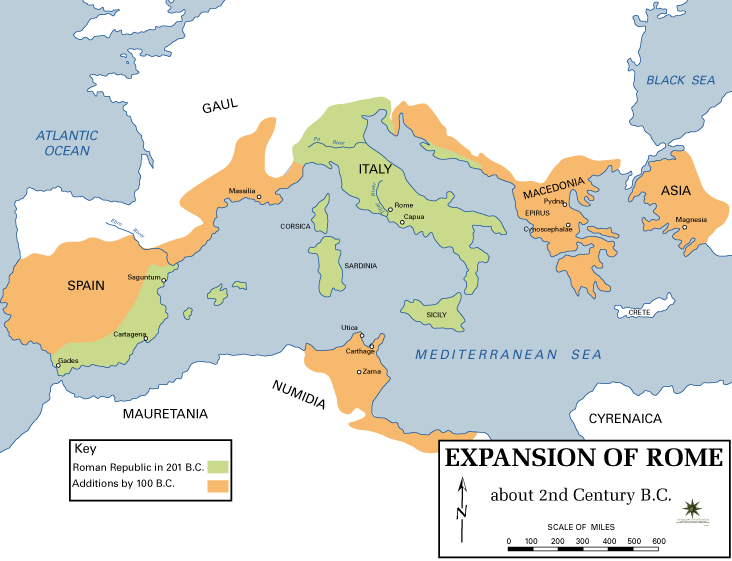
Ficheiro:Expansion of Rome, 2nd century BC.gif
The 1st-century BC Greek historian Dionysius of Halicarnassus indicates that the Roman institution of slavery began with the legendary founder Romulus giving Roman fathers the right to sell their own children into slavery, and kept growing with the expansion of the Roman state. Slave ownership was most widespread throughout the Roman citizenry from the Second Punic War (218–201 BC) to the 4th century AD.
The Twelve Tables, Rome's oldest legal code, have brief references to slavery, indicating that the institution was of long standing. In the tripartite division of law by the jurist Ulpian (2nd century AD), slavery was an aspect of the ius gentium, the customary international law held in common among all peoples. The "law of nations" was neither natural law, which existed in nature and governed animals as well as humans, nor civil law, which was the body of laws specific to a people. All human beings are born free (liberi) under natural law, but slavery was held to be a practice common to all nations, who might then have specific civil laws pertaining to slaves. In ancient warfare, the victor had the right under the ius gentium to enslave a defeated population; however, if a settlement had been reached through diplomatic negotiations or formal surrender, the people were by custom to be spared violence and enslavement. The ius gentium was not a legal code, and any force it had depended on "reasoned compliance with standards of international conduct."
In 216 BCE, Marcus Ameilius Lepidus, late consul and augur, was honoured by his sons with three days of gladiatora munera in the Forum Romanum, using twenty-two pairs of gladiators. Ten years later, Scipio Africanus gave a commemorative munus in Iberia for his father and uncle, casualties in the Punic Wars. High status non-Romans, and possibly Romans too, volunteered as his gladiators. The context of the Punic Wars and Rome's near-disastrous defeat at the Battle of Cannae (216 BCE) link these early games to munificence, the celebration of military victory and the religious expiation of military disaster; these munera appear to serve a morale-raising agenda in an era of military threat and expansion. The next recorded munus, held for the funeral of Publius Liciniusin in 183 BCE, was more extravagant. It involved three days of funeral games, 120 gladiators, and public distribution of meat.File:Italy and environs, 218 BC.gif
The enthusiastic adoption of gladiatoria munera by Rome's Iberian allies shows how easily, and how early, the culture of the gladiator munus permeated places far from Rome itself. By 174 BC, "small" Roman munera (private or public), provided by an editor of relatively low importance, may have been so commonplace and unremarkable they were not considered worth recording:
Many gladiatorial games were given in that year, some unimportant, one noteworthy beyond the rest — that of Titus Flamininus which he gave to commemorate the death of his father, which lasted four days, and was accompanied by a public distribution of meats, a banquet, and scenic performances. The climax of the show which was big for the time was that in three days seventy four gladiators fought.
In 105 BCE, the ruling consuls offered Rome its first taste of state-sponsored "barbarian combat" demonstrated by gladiators from Capua, as part of a training program for the military. It proved immensely popular. The ludi (state games), sponsored by the ruling elite and dedicated to deity a divine or heroic ancestor, began to include the gladiator contests formerly restricted to private munera.
Belligerents
Army of escaped slavesRoman Republic
Commanders and leaders
Spartacus†
Crixus†
Oenomaus†
Castus†
Gannicus†
Gaius Claudius Glaber†
Publius Varinius†
Gnaeus Cornelius Lentulus Clodianus
Lucius Gellius Publicola
Gaius Cassius Longinus
Gnaeus Manlius
Marcus Licinius Crassus
Gnaeus Pompeius Magnus
Marcus Terentius Varro Lucullus
Lucius Quinctius
Gnaeus Tremellius Scrofa
Strength
120,000 escaped slaves and gladiators, including non-combatants; total number of combatants unknown.3,000+ militia
8 Roman legions (40,000–50,000 men)
12,000+ other troops
Casualties and losses
30,000 (including Crixus) killed by Lucius Gellius Publicola, 6000 crucified by Crassus, 5000 crucified by Pompeii, almost all others killed or crucifiedUnspecified but heavy
(50, 1,000, or 4,000 lost through decimation)
According to the differing sources and their interpretation, Spartacus either was an auxiliary from the Roman legions later condemned to slavery, or a captive taken by the legions. Spartacus was trained at the gladiatorial school near Capua, belonging to Lentulus Batiatus. In 73 BC, Spartacus was among a group of gladiators plotting an escape.
The plot was betrayed but about 70 men seized kitchen implements, fought their way free from the school, and seized several wagons of gladiatorial weapons and armor. The escaped slaves defeated a small force sent after them, plundered the region surrounding Capua, recruited many other slaves into their ranks, and eventually retired to a more defensible position on Mount Vesuvius.
Once free, the escaped gladiators chose Spartacus and two Gallic slaves—Crixus and Oenomaus—as their leaders. Although Roman authors assumed that the slaves were a homogeneous group with Spartacus as their leader, they may have projected their own hierarchical view of military leadership onto the spontaneous organization of the slaves, reducing other slave leaders to subordinate positions in their accounts.

Now you are about to see the view that the generals wish to have, and see the flexible and heavily armed romans legions against the slaves with hungry of freedom led by professional gladiators, the fight will decide the future of Rome and the freedom and peace of the people on both sides, and the world will not be the same before!

sexta-feira, 2 de novembro de 2012

History Channel Decisive Battles E06 The confrontation of two warfare cultures, Battle of Cynoscephalae, North Greece (June 197 BC)

In 204 King Ptolemy IV Philopator of Egypt died, leaving the throne to his six-year old son Ptolemy V. Philip V of Macedon and Antiochus the Great of the Seleucid Empire decided to exploit the weakness of the young king by taking Ptolemaic territory for themselves and they signed a secret pact defining spheres of interest. Philip first turned his attention to the free Greek city states in Thrace and near the Dardanelles. His success at taking cities such as Kios worried the states of Rhodes and Pergamon who also had interests in the area.
In 201, Philip launched a campaign in Asia Minor, besieging the Ptolemaic city of Samos and capturing Miletus. Again, this disconcerted Rhodes and Pergamon and Philip responded by ravaging the territory of the latter. Philip then invaded Caria but the Rhodians and Pergamonians successfully blockaded his fleet in Bargylia, forcing him to spend the winter with his army in a country which offered very few provisions.
At this point, although they appeared to have the upper hand, Rhodes and Pergamon still feared Philip so much that they sent an appeal to the most powerful state in the Mediterranean: Rome.
File:218BCMAPMEDITERRANEAN.jpg
Rome had just emerged victorious from the Second Punic War against Hannibal. Up to this point in her history, she had taken very little interest in the affairs of the eastern Mediterranean. The First Macedonian War against Philip V had been over the issue of Illyria and was resolved by the Peace of Phoenice in 205. Very little in Philip's recent actions in Thrace and Asia Minor could be said to concern Rome personally. Nevertheless, the Romans listened to the appeal from Rhodes and Pergamon and sent a party of three ambassadors to investigate matters in Greece. The ambassadors found very little enthusiasm for a war against Philip until they reached Athens. Here they met King Attalus I of Pergamon and diplomats from Rhodes. At the same time, Athens declared war on Macedon and Philip sent a force to invade Attica. The Roman ambassadors held a meeting with the Macedonian general and urged Macedon to leave every Greek city in peace and come to an arrangement with Rhodes and Pergamon to adjudicate damages from the latest war. The Macedonian general evacuated Athenian territory and handed the Roman ultimatum to his master Philip.
Philip, who had managed to slip past the blockade and arrive back home, rejected the Roman ultimatum out of hand. He renewed his attack on Athens and began another campaign in the Dardanelles, besieging the important city of Abydus. Here, in the autumn of 200, a Roman ambassador reached him with a second ultimatum, urging him not to attack any Greek state or to seize any territory belonging to Ptolemy and to go to arbitration with Rhodes and Pergamon. It was obvious that Rome was now intent on making war on Philip and at the very same time the ambassador was delivering the second ultimatum, a Roman force was disembarking in Illyria. Philip's protests that he was not in violation of any of the terms of the Peace of Phoenice he had signed with Rome were in vain.
Polybius reports that during the siege of Abydus, Philip had grown impatient and sent a message to the besieged that the walls would be stormed and that if anybody wished to commit suicide or surrender they had 3 days to do so. The citizens promptly killed all the women and children of the city, threw their valuables into the sea and fought to the last man. This story illustrates the reputation for atrocities that Philip had earned by this time during his efforts at expanding Macedonian power and influence through conquest of Greek cities.
File:Macedonia and the Aegean World c.200.png
Philip found himself with few active allies in Greece, but there was little enthusiasm for the Roman cause either, the Greeks remembering the frequent brutality of the legions during the First Macedonian War. Most states adopted a policy of waiting to see which way the war went. For the first two years, the Roman campaign was lacklustre. Publius Sulpicius Galba made little headway against Philip and his successor, Publius Villius, had to deal with a mutiny among his own men. In 198, Villius handed command over to the Titus Quinctius Flamininus, who would prove a very different kind of general.
Flamininus was not yet thirty and was a self-proclaimed ardent Philhellene. He introduced a new Roman policy for winning the war. Up to this point, the Romans had merely ordered Philip to stop attacking Greek cities ("peace in Greece"). Now Flamininus demanded that he should withdraw all his garrisons from the Greek cities he already held and confine himself to Macedon ("liberty for the Greeks").
Flamininus led a vigorous campaign against Philip in 198, forcing him to retreat to Thessaly. The cities of the Achaean League, traditionally favourable to Macedon, had been too busy with their war against Sparta to take any part in the Second Macedonian War so far. Roman success against Philip persuaded many of them to abandon their pro-Macedonian stance. Others, such as Argos, remained loyal to Philip. 
Belligerents
Roman Republic
Aetolian League allies
Macedon
Commanders and leaders
T. Quinctius FlamininusPhilip V of Macedon
Strength
about 33,400 men or about the same number as the Macedonians according to Plutarch25,500 men according to Plutarch
Casualties and losses
about 2,000 killed or wounded5,000 killed, 1,000 captured

Philip declared his willingness to make peace, but his overtures came at a critical time for Flamininus just as elections were being held in Rome. Flamininus was eager to take the credit for ending the war but he did not yet know whether his command would be prolonged. He decided to negotiate with Philip while he awaited the outcome of the elections. If they meant he was to be recalled to Rome, then he would make a quick peace deal with the Macedonian. If, on the other hand, his command was extended, then he decided to break off the negotiations and declare war on Philip again. Flamininus and Philip met at Nicaea in Locris in November 198. To prolong the proceedings, Flamininus insisted that all his allies should be present at the negotiations. Flamininus reiterated his demands that Philip should withdraw from the whole of Greece. Philip, who was prepared to give up all his recent conquests in Thrace and Asia Minor, could not go this far. Flamininus persuaded him that the problem was the Greek states who were insisting on this point and suggested he should send an embassy to the Roman Senate. Philip followed his advice but at this moment Flamininus learned that his command had been extended and his friends in Rome successfully interfered with the Macedonian negotiations in Rome so the war could continue.
Seeing things were going Rome's way, Philip's few remaining allies abandoned him (with the exception of Acarnania) and he was forced to raise an army of 25,000 mercenaries. The legions of Titus confronted and defeated Philip at the Aous, However the decisive encounter came at Cynoscephalae in Thessaly in June 197 BC.

Now you are about to see the view that the generals wish to have, and see the Phalanx infanty and the Companion Cavalry of Macedon against the flexible and heavily armed romans legions and their supports, the fight will decide the future of Greece and which one is the best way of fighting wars, and the world will not be the same before!